Why Digital Marketing Is Important for Small Business
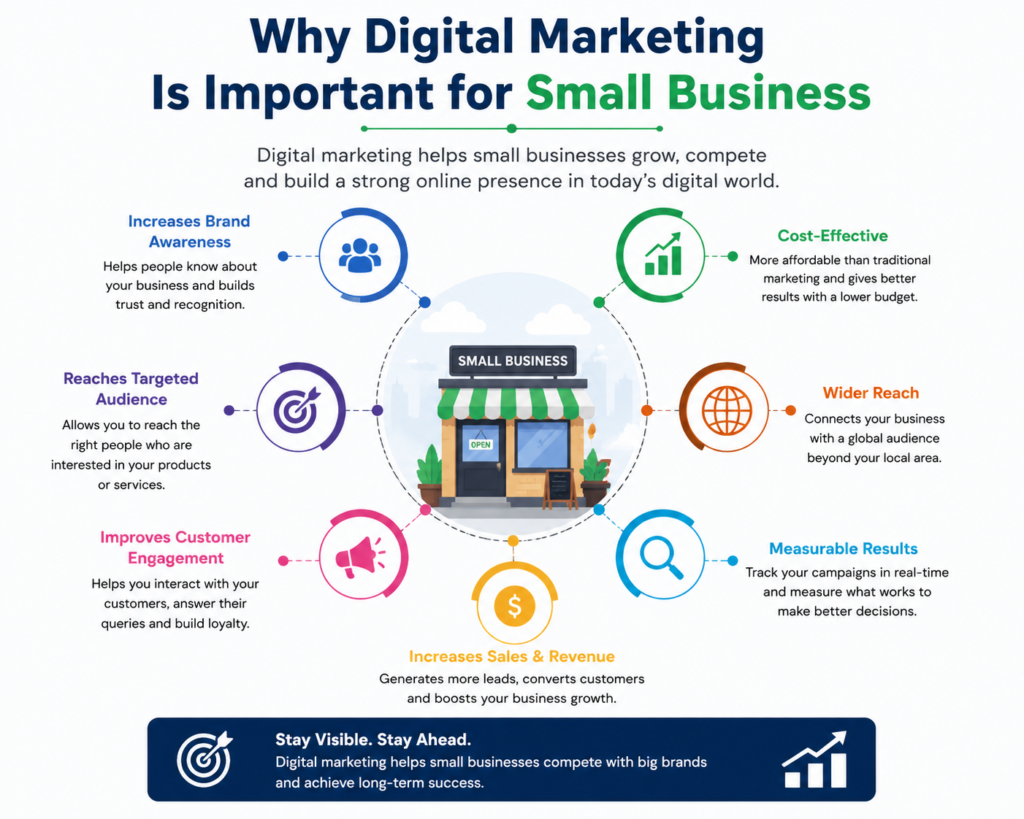
In today’s connected world, having a strong online presence is a lifeline for small businesses and startups. The digital marketing market is booming – global digital ad spending is on track to hit $740 billion by 2026 – and over half of all small firms now rely on online channels to reach customers. For each dollar spent online, businesses typically earn about $5 back, far higher returns than traditional media. These trends show that even with a tight budget, local companies can use digital marketing services to grow quickly and compete with bigger brands.
Digital marketing levels the playing field. By using search engine optimization (SEO), social media, and targeted ads, small firms can extend their reach beyond local markets and tap into customers anywhere. For example, optimizing for organic search can drive 53% of a website’s traffic, and leveraging social platforms connects you to millions of engaged users – there are nearly 5.8 billion social media accounts worldwide as of 2026. Plus, tools like chatbots and instant messaging let you engage customers 24/7, building loyalty with quick answers and support. In fact, businesses using AI chatbots report 30–45% reductions in support workload and faster case resolution. In short, even on a low budget, Digital Marketing Services give small businesses a global reach and around-the-clock engagement that was once only possible for big companies.
Market Trends & Key Stats
- Rapid Growth: The digital marketing industry is expanding fast. Recent analysis shows a 13–15% annual growth rate through 2026, as more businesses move budgets online. Small companies that invest 7–8% of revenue in digital marketing often see 2–3× ROI compared to traditional ads.
- Ad Spend: In 2026, global digital ad spend will reach about $740 billion, accounting for over 70% of all advertising. This huge market now includes even small firms — with affordable ad platforms, new entrants can compete.
- Social Reach: Nearly 5.8 billion people use social media regularly. Over half of small businesses engage daily on social networks to talk with customers. Because social media use is so widespread, even local startups can build visibility by posting content or running ads on platforms like Facebook, Instagram or LinkedIn.
- SEO Impact: Organic search remains key for free traffic. Nearly 53% of website visits come from search engines when sites are well-optimized. While SEO takes time (visible gains often come in 4–6 months of consistent effort), its traffic is essentially “free” and compounds over time.
- Email Marketing: Email still has one of the highest returns. A good email open rate is around 20–25%, and for every $1 spent on email, businesses can see $36–$45 back. This means email campaigns often drive more repeat e-commerce sales than social ads, making them a cost-effective tool for customer retention.
- PPC Ads: Pay-Per-Click (PPC) campaigns can double or triple conversions compared to broad marketing. By targeting only interested users, small firms cut wasted spend. (For example, small-budget PPC ads might cost $0.50–$2 per click, whereas a single TV spot can run $50+ in ad cost.)
Together, these stats show that digital marketing services give small businesses measurable, high-ROI tools to grow.
Key Benefits: Reach, Engagement & Budget Efficiency
Digital marketing offers several core advantages for startups and small companies:
- Global Reach on a Local Budget: Online tools let you reach customers anywhere. A startup in Nagpur can attract buyers in Mumbai or Delhi just as easily as local ones, by appearing in Google search results or social feeds. SEO and paid ads use precise targeting (by location, age, interests, etc.), so even a small budget can home in on the most likely customers.
- 24/7 Customer Engagement: Unlike a storefront or a TV ad, your website and social channels are always open. Chatbots and automated messaging handle common questions instantly, reducing the need for round-the-clock staff. Surveys show AI chatbots resolve 33–45% of support inquiries faster, improving first-contact resolution by ~30%. This means happy customers and less work for you.
- Level Playing Field with Big Brands: Big companies often have huge marketing budgets, but you can compete by being smarter. Digital marketing lets you target niche audiences that big brands overlook. For example, localized SEO ensures your store shows up for “near me” searches – Google says about 46% of all searches have local intent. By focusing on local keywords and community-based content, you can capture nearby customers without huge spending. Social ads and remarketing keep your brand in front of users who’ve already shown interest, even if national brands dominate TV or broad media.
- Data-Driven Growth: Every digital channel provides clear metrics. Using Google Analytics or ad platform dashboards, you can track exactly how many leads or sales each campaign generates. Many small firms see 2–3× higher ROI by reallocating budgets to digital channels that perform best. For example, businesses often set a 4:1 return goal (getting $4 in revenue for every $1 spent), which is feasible with well-optimized campaigns. Even email marketing alone can outperform social: one study shows email yields roughly 7× the conversion rate of social media. With these insights, you waste less money and double down on strategies that work.
Tailored Strategies for Different Businesses
Digital marketing isn’t one-size-fits-all. Here’s how various types of small businesses can benefit:
E-commerce & Startups – Drive Sales and Recover Lost Revenue
- Targeted Ads Cut Costs: By using Facebook/Instagram or Google Shopping ads targeted by demographics and interest, e-commerce stores reduce acquisition costs by up to 50% compared to untargeted campaigns. Ads cost less and convert more when they reach the right shoppers.
- Recover Abandoned Carts: Up to 70% of online shopping carts are abandoned. Digital marketing can recapture a big chunk of this lost revenue. Automated email or ad retargeting campaigns can typically recover about 10–15% of abandoned cart sales. (For example, if a customer leaves items in their cart, a follow-up email with a discount can bring many back to complete the purchase.)
- Repeat Sales via Email: Since email marketing has high ROI, e-commerce businesses should build subscriber lists. Sending personalized offers and product recommendations to past customers can significantly boost repeat purchases. With open rates around 20-25%, even small email lists can translate into steady sales and loyalty.
Service Businesses – Capture Local Customers
- Local SEO & “Near Me” Searches: Services (plumbers, cafes, retailers) depend on local foot traffic. Optimizing for local search means listing your business correctly on Google My Business, Bing Places, and local directories. As noted, about 46% of Google searches have local intent, so appearing in those results is critical. Also, the top 3 local listings get over 75% of clicks – so focusing on local SEO drives more visits and calls.
- Online Reviews & Reputation: Customers trust online reviews. Studies show over 90% of people read reviews before buying. Encouraging happy clients to rate your business on Google or Facebook, and then highlighting those reviews in your digital marketing, builds trust and turns searchers into customers.
- Engagement & Referrals: Small service providers can use social media to showcase work (photos of completed projects, customer testimonials) and interact with the community. Engaging content and quick responses (via chat or messenger) keep customers interested. Word-of-mouth spreads online too: satisfied customers often share business pages, extending your reach for free.
Personal Brands / Influencers – Monetize and Grow Audience
- Content Repurposing: Creators and personal brands can multiply their content impact by repurposing it across platforms. A blog post can become a series of LinkedIn updates or short YouTube/Reels clips, tripling engagement with minimal extra effort. Consistent, cross-platform content helps build a loyal following.
- Email Lists & Partnerships: Influencers should capture audience attention by offering newsletters or exclusive content. Since email yields the highest ROI, even influencers use emails to promote products or affiliate deals. Building an email list is effectively building an asset – this owned audience can be monetized through sponsored content and collaborations.
- Micro-Targeting Ads: Influencers on a budget can run small Facebook/Instagram ad campaigns to promote events or merchandise. By targeting their niche community directly, they can drive sales (e.g. selling courses, products, or memberships) and measure every rupee spent.
Corporate Small Firms – Defend Market Share & Reputation
- Integrated Personalization: Even growing startups or regional firms (think a fast-expanding hospital chain or education provider) can use marketing automation and CRM integration to nurture leads. Personalizing email and ad content using CRM data (e.g. past purchases or interests) can boost B2B lead conversion. (Research shows CRM-driven personalization can significantly improve lead quality and customer loyalty.)
- Crisis Management & PR: For small corporates, social listening and online reputation are critical. Digital marketing tools monitor mentions and sentiment, letting businesses address negative feedback or misinformation quickly. A swift, professional response online can protect reputation and market share. (For example, a PR incident in a competitor can be an opportunity to highlight your brand’s strengths through digital content.)
- Loyalty & Community: Corporates can use email newsletters, exclusive social groups, or webinars to keep clients and partners engaged. These tactics reinforce brand loyalty and make it harder for big brands to lure away customers. Over time, a well-nurtured audience becomes a stable base of revenue.
Smart Strategies & Measurable ROI
Small businesses should focus on cost-effective, data-driven tactics:
- A/B Testing on a Budget: Start with a small ad spend (often as low as ₹500–₹1000 per month per channel). Test different headlines, images, or offers in ads to see what works best. Many small companies achieve a 4:1 return on ad spend by continuously optimizing (for example, Google Ads and Facebook Ad campaigns allow precise tracking of which ads generate leads or sales).
- Email First, Paid Later: Because email delivers huge ROI, build an email strategy early. Send newsletters or promotional emails to engage existing contacts. In fact, email’s conversion rate (~4.2%) is far higher than social (~0.6%). Once your email and SEO channels are established, you can layer in paid ads (PPC) and social media ads to scale. This keeps initial costs low while organic channels grow.
- 24/7 Availability with Chatbots: Implement simple chatbots on your website or messaging apps. Even a basic bot that answers FAQs or collects lead info can reduce customer service workload by ~30%. It also means visitors get instant responses, which improves satisfaction and can capture leads outside of business hours.
- Continuous Monitoring: Use analytics to set SMART goals (e.g. “increase monthly leads by 20% in 3 months”). Check campaign performance weekly. If a channel (say, one type of social ad or a content series) isn’t delivering, reallocate resources to better-performing tactics. This agile approach – test, measure, pivot – ensures every rupee is well spent.
Implementation Steps (Quick Guide):
- Audit Your Website: Make sure it loads fast and works on mobile (Google’s Mobile-Friendly Test can help). A slow site or broken links cost you customers.
- Define Clear Goals: Decide what “success” looks like (leads, calls, online sales, newsletter sign-ups) and set targets (e.g. 20% more leads in 6 months).
- Choose 2–3 Channels: Focus where your audience is. Local services often start with Google SEO + Google Ads, while influencers might start with Instagram + email.
- Create Quality Content: Whether it’s blog posts, short videos, or graphics, make content that educates or entertains your target customer.
- Track & Optimize: Use Google Analytics, Facebook Insights, or email reports. If one strategy underperforms (low clicks or high cost per lead), refine your message or try a new approach.
Following these steps helps small businesses compete and grow steadily without overspending.
2026 Digital Marketing Trends to Watch
Staying updated on trends ensures long-term success:
- AI-Powered Personalization: Advanced tools use AI to tailor content. For example, email platforms now automate personalized product recommendations or send messages at the perfect time. Companies using AI-driven personalization report up to 41% higher revenue from campaigns. In ads, AI can automatically optimize bids and audiences, often boosting conversions by ~25%. Investing in AI-enabled marketing tools early can give small firms an edge over slower competitors.
- Voice Search & Video: More people use voice assistants and watch short videos. Optimizing for voice search (using natural language keywords and FAQs) can capture growing traffic. Similarly, creating short-format videos (Reels, Shorts, TikToks) can dramatically increase engagement: smart creators repurpose long blog posts into bite-sized clips to triple views and interactions. Embrace these formats to stay visible.
- Privacy-First Marketing: With cookies going away, focus on first-party data and trust. This means collecting customer emails and permissioned data directly (like newsletter sign-ups), being transparent about data use, and building loyalty through great service. Brands that emphasize privacy and data protection win customer trust – for example, personalized email offers (where the user opted in) feel more reliable than mystery ads.
By adapting to these trends now, even small businesses can build future-proof marketing plans.
Take Action: Scale Your Business Smartly
Digital marketing is a powerful equalizer. Even if your budget is small, smart Digital Marketing Services can deliver big results. Whether you run a local shop, an online store, a personal brand, or a growing company, there are tailored strategies to help you compete with bigger names, drive sales, and build lasting customer relationships.
Ready to get started? Contact Nagpur Digital Solution today for a free digital marketing audit – and learn how we can help your business grow online without breaking the bank. Start with a free audit — scale smart.