Why Digital Marketing Is Crucial in Today’s Business Landscape
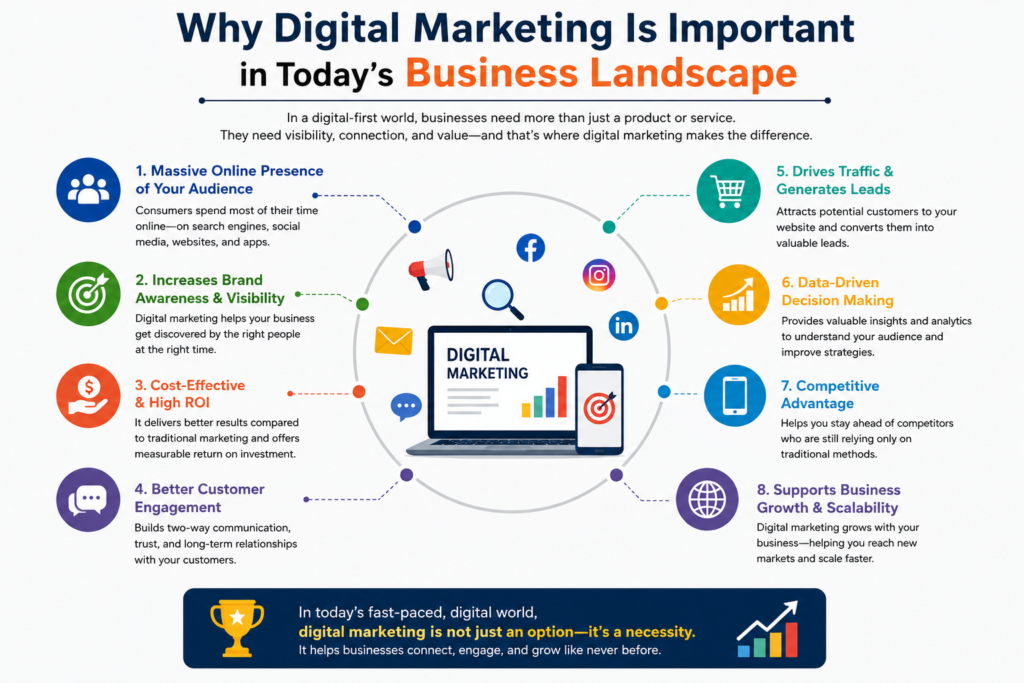
The digital marketing world is booming. Global ad spending on digital media is now enormous – from about $667 billion in 2024 to nearly $800 billion by 2026. This means digital channels (search, social, mobile, video, etc.) now capture over 65% of all advertising dollars worldwide. Even amid inflation or slow economies, most businesses are not cutting digital budgets. In fact, one report finds 68% of small business owners plan to increase their marketing budget in 2026. In India, the story is similar: Statista projects digital ad spend will grow from about ₹160 billion in FY2019 to roughly ₹539 billion by FY2026, a jump of about 25–30% per year. In short, companies trust digital because it works – it reaches buyers where they live (on smartphones and computers), scales to any budget, and gives real-time data on every rupee spent. Nagpur Digital Solution, as a local digital marketing company, sees this growth first-hand: nearly every small business we talk to is either moving ads online or planning to do so.
Small Businesses: Competing Locally on a Budget
For neighbourhood shops, clinics, salons and other small businesses, digital marketing levels the playing field. Around three-quarters of SMBs say they use some form of online advertising, and many are shifting money from newspapers and banners to the internet. One big reason: “near me” searches. Today most people first look online for a local service. By claiming a free Google Business Profile (GBP) and optimizing it (hours, photos, services, etc.), a small shop can appear in those searches. Data show 76% of businesses verify their Google listing, and verified profiles get ~12% more phone calls and ~10% more directions requests. In practice this means a bakery or plumber can get 10–15 new leads each month just by being visible on Google Maps – all at almost no cost.
Another advantage: targeted local ads. Platforms like Google Ads let you set a small radius around your store so every click or rupee goes to nearby customers. These local-targeted ads often cost much less per lead than big billboards or print ads. For example, a local Google search ad might cost ₹5–₹10 per click, whereas a poster on the roadside could cost thousands for far less engagement. Not surprisingly, small businesses focus on social and email too: in one survey, 68% of small business owners said social media and email will drive most of their sales in 2026 (versus only 26% relying on traditional media).
Actionable tip: As a small business, start simple. Claim and verify your Google Business Profile now. Add complete info, photos, and encourage customers to leave reviews (good reviews boost search rankings). Then pick 1–2 digital channels. For instance, you might run a small radius-targeted Google Ads campaign alongside active WhatsApp or Instagram messaging. Focus on nearby customers with a clear offer (e.g. “Visit our salon this week for 20% off”). Track each channel (number of calls or messages from Google Ads vs. Facebook) to see what works best. Over time, this lets a small shop get steady leads day and night – even when the physical store is closed.
Startups & New Businesses: Test Fast, Grow Smart
For startups and new ventures, digital marketing is the growth engine. Young companies often spend 10–15% (or even up to 30%) of their early revenue on marketing. But instead of TV or print, they use digital ads and content so they can test ideas quickly. A typical playbook: build a focused landing page (one clear value proposition and “Sign Up” button) and run small Google Search ads or Facebook ads to it. Instantly you learn if customers click and sign up – and at what cost per click or per lead. This performance data is gold: investors and founders love to see exact ROI, e.g. “₹500 spent yielded 10 leads, for a ₹50 cost-per-lead.”
Digital lets startups pivot fast and frugally. Need to test demand in a new city? Scale up geo-targeted ads. Want to tweak your messaging? Change an ad headline or creative overnight. Unlike old-school referrals or cold calls, every campaign gives clear metrics. This drives growth: for instance, companies that focus on data-driven marketing typically grow 30%+ faster than competitors.
Content also plays a big role. Publishing helpful blog posts, LinkedIn articles or short videos builds authority without heavy expense. In fact, data shows content marketing can deliver 3× more leads at about 60% lower cost than traditional outreach. (SEO and good content may take months to ramp up, but they “compound” – traffic and leads keep rising long after the initial work.) Meanwhile, PPC ads provide immediate visibility. By mixing both – SEO/content for long term and paid ads for instant results – startups achieve the best of both worlds.
Actionable tip: Start with a clear landing page and a small ad campaign. E.g. create a Google Ads search campaign targeting your main keywords (or a Facebook ad with interest targeting). Allocate maybe 80% of your budget to “compounding” channels (like SEO/content) and 20% to “short-term” channels (like PPC). Keep a content calendar: publish one blog or LinkedIn post each week about a pain point you solve. Always set up tracking (Google Analytics, Facebook Pixel) to see which ads or posts actually bring clicks, leads, or sign-ups. Over time, double down on what works: if a certain ad yields cheap sign-ups, spend more; if a blog generates steady SEO traffic, write more on that topic.
E-Commerce Businesses: Driving Sales with Search, Social, and Email
For online stores, digital marketing is literally the sales lifeline. In e-commerce, search ads are king – people searching online often have intent to buy. In fact, roughly 36% of all digital ad spend is on search. That means shopping ads (Google Shopping, Amazon ads) and search-engine results pages reach customers exactly when they’re looking to purchase. Alongside search, social platforms like Meta (Facebook/Instagram) and marketplaces (Flipkart, Amazon) offer product catalogues and dynamic ads to showcase inventory.
But conversion doesn’t stop at the first click. Smart e-commerce brands use retargeting and email automation to keep customers engaged. For example, if a visitor leaves items in their cart, a retargeting ad (or cart-abandonment email) can bring them back. This works: one study found retargeted ads improve conversions by ~30–50% on average, and personalized email sequences can recover another 18–25% of shoppers. Email marketing itself is extremely cost-effective: on average it returns about $36 for every $1 spent. In practice, a series of automated emails (welcome series, cart recovery, post-purchase thank-you) can generate a large share of revenue with minimal ongoing cost.
Overall, digital marketing for e-commerce means capturing intent and nurturing customers. Use Google Analytics and ad pixels to track which products get clicks and buys. Run shopping ads for your best sellers. Then layer on remarketing (for example, show the exact product a user viewed in a Facebook ad later). Automate follow-up emails offering discounts or related products. This multiplies your sales. In short, e-commerce brands that harness search, social, and email can see conversion rates and repeat purchases climb far above “generic” advertising.
Service-Based Businesses: Building Trust and Leads Online
If you run a service (consulting, design agency, doctor’s clinic, etc.), digital marketing helps build credibility and attract clients. Today most people research service providers online before picking up the phone. That means your Google profile, reviews, and content must impress. For example, Google alone hosts roughly 80% of all online business reviews. A home service with 20 five-star Google reviews will leapfrog a competitor with no reviews when customers search. Positive reviews and an up-to-date Google Business listing can translate directly into more calls and emails (one study shows verified profiles get ~12% more calls).
Content also earns trust. Firms that regularly publish helpful blogs, case studies or videos tend to get far more leads than those that stay silent. In fact, industry benchmarks show content marketing delivers about 3× more leads than outbound tactics (cold calls, print ads) at much lower cost. For example, a local accountant writing a blog about “How to file taxes online” or a fitness coach posting success-story videos on Instagram will attract people who might never have known they exist.
Actionable tip: Start by optimizing for local search. Make sure your service pages include location keywords (“Nagpur digital marketing consultant”, “Nagpur salon services” etc.), and ask all happy clients to leave Google reviews. On your website and social media, share case studies or testimonials (“How we helped Raj’s Bakery double its sales in 3 months”). Use LinkedIn (for B2B services) or Facebook/Instagram (for B2C) to post tips and success stories. Over time, your business will come to mind first when people need your expertise – not as “just another agency” but as a trusted local authority.
Personal Brands & Influencers: Monetizing Your Audience
For online retailers and marketplaces, digital marketing is the lifeblood that drives traffic and sales around the clock:
- 24×7 Global Marketplace: Your website or e-commerce store never closes. Digital marketing feeds a constant flow of visitors globally. Performance ad platforms (Google Ads, Facebook/Instagram Ads, TikTok Shopping) let you target people ready to buy. With tracking pixels, every click ties to a cart, sale or signup – enabling real ROI calculation (like Return on Ad Spend (ROAS)). Well-optimized brands often see 2–4× ROAS on e-commerce ads.
- Mobile Commerce (M-commerce): Since over 70% of e-commerce traffic comes from mobile, your ads and websites must be mobile-optimized (fast, easy checkout). Short-form video ads (like Instagram Reels or YouTube Shorts) now double year-over-year, and can link directly to purchase pages. Social commerce features (shoppable posts on Instagram/Facebook or TikTok Shop) mean customers can buy with one tap from the app.
- Data-Driven Scaling: Use analytics (Google Analytics, Shopify stats) to optimize constantly. For example, if one Facebook ad for “women’s sandals” is converting at ₹200 CAC (cost per acquisition) but another “men’s jackets” ad is ₹600, shift budget toward the sandal ad. This data-driven tuning is impossible in offline media.
- Personalized Marketing: E-commerce thrives on personalization. Email and SMS sequences triggered by behaviour (like cart abandonment reminders, or product recommendations based on browsing history) can recover sales that otherwise drop off. Chatbots and AI-powered assistants can answer questions or upsell 24/7, increasing cart value.
- Influencer and Content Shop: For product brands, influencer partnerships (short honest reviews or demo videos) can be huge. In fact, 86% of consumers make a purchase inspired by an influencer at least once a year. Including UGC and reviews in your ads and listings further boosts trust.
Put simply, if you run an e-commerce site, digital marketing is how customers find you and buy from you anytime. Missing out means leaving sales on the table.
Corporate Companies: Data-Driven Scale and Reputation
Large enterprises have the biggest budgets and also the biggest stakes in digital marketing. They shift chunks of their media spend into data-driven channels because digital is measurable and scalable. A corporation can run multi-channel campaigns – Google search and display ads, Facebook/Instagram and LinkedIn campaigns, email newsletters, and more – all tied to a central analytics system. With tools like CRM-integrated marketing automation, firms can personalize communication for millions of customers: for example, an automated email that sends a personalized offer on a customer’s birthday or a dynamic ad that shows relevant products based on past purchases.
The payoff can be huge. Studies show data-driven organizations grow revenue much faster – often 30%+ annually – compared to those that lag behind (under 10% growth). Big brands also invest in AI and automation to manage these campaigns. For example, only 2% of automated emails drive about 41% of revenue in some firms. That means by automating the right email sequences (welcome, reminders, upsells), companies can vastly multiply lifetime value.
In the corporate world, digital marketing is not just a supplemental channel – it’s core to defending market share. When a new competitor runs ads or an influencer campaign, the large firm must respond digitally. Likewise, if a reputation issue hits online (negative reviews or PR), corporations have the tools to react on social media and search instantly. With constant A/B testing, real-time dashboards and AI-powered personalization, big companies can protect and grow their brand at scale, something impossible with only traditional methods.
Core Benefits of Digital Marketing
Across all business types, digital marketing offers benefits hard to achieve offline:
- Expanded Reach & Precise Targeting: Digital ads aren’t limited by geography. A single Google or Meta ad account can target “Nagpur, age 25–35, interested in cooking” or “all of India, tech enthusiasts” with the flip of a switch. This hyper-targeting means a roadside shop can serve only local households, and an export business can reach international buyers. Tools like Google Ads let you pick location radius, demographics, devices, even user interests. For example, a bakery can target mobile searchers within 5 km, so every ad rupee goes to nearby customers most likely to visit.
- Cost-Effectiveness & High ROI: Digital campaigns are tightly controllable. You set daily caps, turn ads off instantly, and see exactly how every rupee is spent. Many studies find 5–8× higher ROI from digital vs. traditional media. For instance, search engine ads can return $8 for every $1 spent (800% ROI), and email marketing often returns ~$36 per $1. Because you can calculate Cost-Per-Lead and Customer Acquisition Cost (CAC) precisely, budgeting becomes smarter. You’ll know it cost ₹200 to acquire a customer via Google and ₹120 via Instagram, and can allocate more to the winner.
- Measurable, Data-Driven Decisions: With platforms like Google Analytics (GA4) and Ads Manager, you get real-time data on impressions, clicks, and conversions. You can see which keywords or ads are working (down to the paisa) and pause the rest. Campaigns become experiments: test two headlines or images, and keep the winner. As one analysis notes, modern businesses can “track ROI in real-time and adjust campaigns on the fly”. This means no more guesswork – decisions are based on data.
- 24×7 Visibility and Scalability: A website or social media profile never sleeps. Even at night or on weekends, online ads and SEO continue to attract leads. For example, a well-SEO-optimized site will get visitors (and leads) months after the content is published, driving down long-term cost per lead. And when seasonal demand spikes (festivals, sales), digital channels can scale instantly by raising budgets; there’s no need to build new stores or print posters.
- Brand Building and Trust: Over 70% of buyers research online before buying, so a strong digital presence builds credibility. Consistent branding across Google, Facebook, LinkedIn and review sites makes a business appear more established. In local markets, a high review rating on Google (where ~80% of reviews live) hugely boosts consumer confidence. In essence, digital marketing tells customers you are real, accessible and customer-focused, which traditional hoardings alone cannot do.
- Personalization and Engagement: Unlike one-size-fits-all ads, digital allows personal touch. You can segment email lists or launch chatbots that answer common customer questions instantly. Targeted ads can show products based on past behavior. Personalized campaigns typically see much higher engagement: for example, segmented email campaigns earn 6× higher transaction rates than generic blasts. Even small businesses can start simple by sending custom WhatsApp messages (birthday discounts, order updates) or using remarketing ads that remind past visitors of the products they viewed. These personal interactions nurture leads much better than broad, impersonal methods.
Know Your Market: Research and Competitor Analysis
Before diving into tactics, it’s smart to research your market and competitors. This means two things:
- Market Research: Use free tools to learn about your audience. Google Analytics (GA4) and Search Console show who visits your website, where they come from, and what keywords they search. Google Trends reveals seasonal peaks or rising topics. On social, tools like Facebook Audience Insights or LinkedIn Analytics tell you the age, interests or job roles of your followers. Compare your performance to industry benchmarks (for example, a 2% conversion rate in your niche). Even simple surveys or feedback forms asking customers “How did you hear about us?” or “What problem are you trying to solve?” can uncover which channels to prioritize.
- Competitor Analysis: Identify your true rivals. Direct competitors are those offering the same product/service in your area; indirect ones might be national brands or substitutes. Check their online presence: what keywords do they rank for (use a free tool like Google Search)? What content do they publish (blogs, videos, case studies)? On social media, note their style of posts, frequency, and engagement. Also look up their ads: Facebook’s Ad Library lets you see current ads running, and tools like SEMrush can show Google Ads their sites use. Create a simple comparison: list each competitor’s main channels and strengths (e.g. “ABC Clinic – strong Facebook presence, lots of patient videos; no recent blogs”; “X Retail – Google Ads & Instagram, but poor Google reviews”). Identify gaps – maybe no one has optimized Google Business, or no one shares customer stories. These gaps are opportunities: your strategy can then be positioned as more complete and customer-friendly than the competition’s.
By doing this groundwork, Nagpur Digital Solution (your local digital marketing company partner) can tailor a strategy specifically to your situation, rather than shooting in the dark.
Getting Started: Actionable Steps by Business Type
Every business is different, but here are practical first steps you can take today. Begin with one step at a time rather than trying everything at once.
- Small Businesses:
- Google Business Profile: Claim and complete your listing. Add accurate hours, a description, photos, and service offerings. Verified GBP pages get about 12% more calls, so this simple step pays off.
- Local SEO: Make sure your website and social profiles list your exact business name, address, and phone (NAP) consistently. Include your city/neighbourhood in page titles and on your site (“Nagpur bakery”, “Panvel hair salon”).
- Pick 1-2 Channels: Rather than spreading thin, start with one paid channel and one organic channel. For example, run a small radius-targeted Google Ad campaign to attract nearby customers, and use WhatsApp Business or Instagram to share daily updates or promotions.
- Engagement and Offers: Use simple CTAs. On social, post a special discount code (“Show this post for 10% off”). Track results by asking new customers how they found you or by monitoring call volume after each campaign.
- Startups & New Businesses:
- Landing Page Setup: Build a focused one-page site or landing page with a single clear message (“Solve X problem”) and a strong call-to-action (sign up, request a quote).
- Test Paid Ads: Launch a small Google Search Ads campaign targeting your main keywords, and one social media campaign (Facebook/Meta for B2C, LinkedIn for B2B). Set daily budgets you can afford (even ₹200–₹300/day can test if your offers get clicks). Measure what each campaign delivers (clicks, sign-ups) and stop what doesn’t work.
- Content Calendar: Plan to publish something helpful each week: a blog post, a LinkedIn article, or even a short explainer video. This builds credibility for free.
- Analyze and Iterate: After a few weeks, review data. What keywords had the cheapest leads? What content got social shares? Use these insights to refine your messaging and where you spend next month.
- E-Commerce Businesses:
- Tracking & Pixels: Install Google Analytics and the Google Ads and Meta Pixels on all pages. This lets you see exactly which ads drive purchases.
- Shopping and Catalog Ads: Set up Google Shopping Ads (if you sell products) and Facebook/Instagram dynamic ads linked to your product catalog. These target people searching or browsing with product listings.
- Retargeting & Email Automation: Create an email automation for cart abandonment (email 1 after a few hours, email 2 after a day). On the ad side, run retargeting ads to people who visited your site but didn’t buy. Even a 5–15% budget allocation to retargeting can boost sales significantly.
- SEO and Page Optimization: Ensure each product page has descriptive titles and bullet points (use schema markup for rich results if possible). This improves your organic rank on Google Shopping and the site.
- Service-Based Businesses:
- Google Business and Local SEO: Optimize your GBP and website for local searches (e.g., “Nagpur accountant,” “best dentist Panvel”). Post regular updates on your GBP like special offers or new services.
- Trust Content: Publish case studies or testimonials on your site and social media. Use real names (with permission) and photos if possible – they build trust. For professionals, writing articles on LinkedIn or hosting Q&A videos helps demonstrate expertise.
- LinkedIn/Instagram Engagement: Choose the platform where your clients are. B2B consultants often find LinkedIn more effective (share industry insights there), while B2C services (like fitness coaches, beauticians) may benefit more from Instagram stories and reels.
- Encourage Reviews: Ask happy clients to leave Google reviews, as this helps you rank higher in “near me” searches and reassures prospects.
- Personal Brands / Influencers:
- Platform Focus: Choose one main platform (YouTube, Instagram, TikTok, LinkedIn) and commit to a regular posting schedule. Quality and consistency are more important than cross-posting everywhere.
- Build an Owned Audience: Create an email newsletter or WhatsApp community for your followers. Give it a reason to exist (exclusive tips, early access, special offers) so people subscribe. This way you’re not solely at the mercy of social algorithms.
- Collaborations and Monetization: Reach out to local or niche businesses about collaborations. Structure deals as affiliate or performance-based (e.g. a 10% commission for every sale from your link). Also consider digital products like e-books or courses, which can be promoted through your content.
- Analyze Growth: Track which posts or videos get the most engagement. If an Instagram reel goes viral, think how to capture those new followers (perhaps direct them to a newsletter signup).
- Corporate Companies:
- Integrate Systems: Use a central CRM (like HubSpot, Zoho, etc.) and connect your marketing tools (email platform, ads accounts) to it. This unifies customer data and lets you run coordinated campaigns (e.g., a Google ad with a follow-up email).
- Multi-Channel Coordination: Plan campaigns that use several channels in concert. For example, launch a new product with Google Search ads, supportive Facebook posts, LinkedIn sponsored content, and an email announcement to existing clients. Track everything in one analytics dashboard.
- AI & Automation: Leverage advanced tools – set up dynamic ads that personalize images or text for each user, or use AI tools to optimize bids and creatives. Automate as much as possible: for instance, use drip email sequences (birthday offers, renewal reminders) to engage millions of customers without extra manpower.
- Measure Brand Health: Monitor brand keywords and sentiment. Use tools to track when your company is mentioned online. Quickly respond to crises (negative reviews or social media posts) to defend reputation in real-time.