Digital Marketing: The Core Growth Engine by 2026
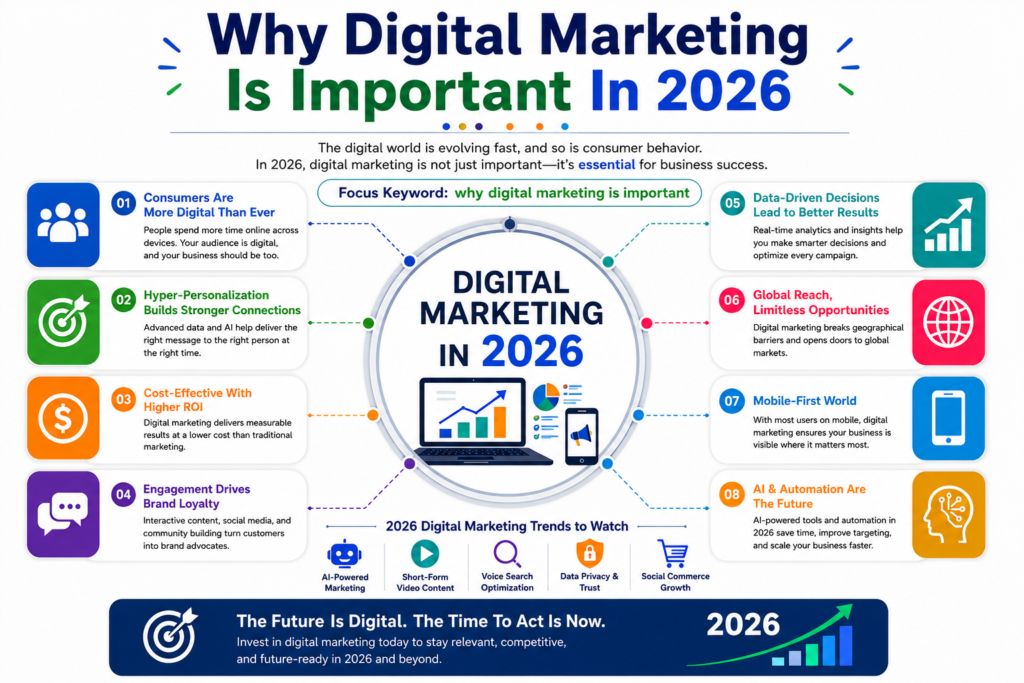
Imagine opening a shop in Nagpur in 2026 without any online presence – it’s like inviting no one through your door. That’s exactly why digital marketing is important in today’s business world.
Modern customers start their journey online, so having a strong digital presence is no longer optional. In fact, most buying journeys begin with an online search, social media browse, or marketplace check, even if the final purchase happens in a physical store. About 81% of shoppers research online before buying. Moreover, the shift to mobile is overwhelming: by 2025 nearly 73% of online purchases will occur on smartphones, and around 72% of global web traffic comes from mobile devices.
This mobile-first world clearly shows Why Digital Marketing Is Important for businesses that want to reach customers where they already spend their time — on their phones, browsing, comparing, and buying products or services.
At Nagpur Digital Solutions, we’ve seen that voice search and AI are changing the game too. Over a quarter of users now use voice assistants (like Siri or Google) to find products or services. Google’s new AI
“overviews” often answer questions without a click, so SEO now means becoming the trusted source that AI cites. This evolution is another reason Why Digital Marketing Is Important for brands that want long-term visibility and authority online. Meanwhile, personalization and data privacy dominate: 92% of marketers use AI and automation for personalized campaigns, and consumers expect tailor-made offers. At the same time, stricter privacy laws mean businesses must earn first-party data with value and consent.
In this environment, digital marketing isn’t optional – it’s essential. Businesses that still question Why Digital Marketing Is Important risk losing market share to competitors who are visible online and actively engaging customers. For instance, digital ads now command roughly 65–75% of the world’s advertising spend, far outpacing TV, radio, or print. This trend is visible in India too: India’s digital ad market is growing about 18–20% annually, driven by the explosive growth of internet users in Tier 2/3 cities and mobile penetration. More than 900 million Indians are online today, and mobile connections cover over 75% of the population.
This guide will show Why Digital Marketing Is Important in 2026 for every type of business – from local shops to big corporations – and how to make it work for you. We’ll cover consumer trends, audience-specific strategies (small businesses, startups, e-commerce, services, influencers, and corporates), competitive insights, and a 30-day action plan with budgets and key metrics. Let’s dive in.
1. How Consumer Behaviour Changed in 2026
By 2026, consumers live online, and their expectations have changed — which is exactly Why Digital Marketing Is Important for businesses trying to stay relevant and competitive in a rapidly evolving market.
Search First, Everywhere:
Around 68% of all online experiences still start with a search engine. Whether it’s Google for products or YouTube for tutorials, consumers begin with research. If your business doesn’t appear in those searches, it’s invisible. Even when shopping offline, 81% of customers do online research first, reading reviews and comparing options. This shift in consumer behavior clearly explains Why Digital Marketing Is Important for businesses that want to attract modern buyers at the right moment.
Mobile-First and Short Attention Spans:
Over 4 hours per day is spent on smartphones worldwide, and short-form video (Reels, Shorts, TikTok) is exploding. By 2025, roughly 73% of e-commerce traffic will be on mobile, and the vast majority of social media interaction comes from phones. In short, if your site or content isn’t designed for mobile and quick engagement, you lose potential customers instantly. This mobile-driven ecosystem is another major reason Why Digital Marketing Is Important in 2026.
Social & Reviews Drive Decisions:
Consumers trust their peers. 93% of people say online reviews influence their buying, and 81% use Google reviews to vet local businesses. Social platforms now blend entertainment and shopping — many buyers discover products via Instagram, WhatsApp, or Facebook before searching for them. Businesses that understand Why Digital Marketing Is Important can use social proof and customer engagement to build trust faster than traditional advertising ever could.
AI and “Zero-Click” Search:
Google now often provides AI-generated answers at the top (zero-click results). To rank, your content must become the source those AI answers draw on. Voice-activated search is also growing rapidly: about 27% of global users use voice assistants to find products. This means optimizing for conversational queries and clear answers (such as FAQ formats) is more important than ever. The rise of AI-powered search is transforming SEO itself and reinforcing Why Digital Marketing Is Important for long-term online visibility.
Privacy & Trust Matters:
With new privacy laws (like India’s DPDP Act) and third-party cookies fading, businesses must collect permission-based data. Consumers now expect value and authenticity, not pushy ads. Authentic content, personal storytelling, and genuine engagement build the trust that today’s savvy users demand. Brands that truly understand Why Digital Marketing Is Important are focusing more on relationships, transparency, and customer experience rather than aggressive selling.
In short, by 2026 the consumer journey is fragmented and always-on. Prospects might see a TikTok, read a review on Google, ask a question to Alexa, then buy on their phone — all within minutes. This omnichannel, mobile, and data-driven reality demonstrates Why Digital Marketing Is Important as the vital core of any modern business strategy focused on growth, visibility, and long-term survival.
2. Why Digital Marketing Matters by Business Type
Different businesses use digital marketing for different goals. Let’s see how each audience group – from small town shops to global brands – benefits:
2.1 Small Business Owners (Nagpur Shops & Startups)
For local shops, vendors, clinics, salons, and other small businesses in Nagpur and across Maharashtra, understanding Why Digital Marketing Is Important can completely transform how they attract customers and compete with larger brands. In 2026, digital marketing doesn’t just promote businesses — it levels the playing field.
Budget-Friendly, Measurable Ads:
One of the biggest reasons Why Digital Marketing Is Important for small businesses is affordability. You can launch Google or Facebook ads with just a few hundred rupees per day (₹500–₹2,000 is common) and start seeing results quickly. Every lead, click, or sale is measurable, so you know exactly which campaigns are generating profit. This is far more transparent and cost-effective than newspaper or radio advertising. In fact, a full-page newspaper ad can cost lakhs with no guaranteed ROI tracking, while digital ads can run even on ₹5/day with highly accurate targeting and measurable performance. According to studies, small businesses using digital campaigns see an average return of $2.80 for every $1 spent.
Local Search Dominance:
Another major reason Why Digital Marketing Is Important is the rise of local search behavior. Most customers now search online using phrases like “best restaurant in Nagpur” or “Nagpur gym classes.” Optimizing your Google Business Profile (GBP) and local SEO strategy can place your business at the top of these local searches. Since 81% of users check Google reviews before choosing a local business, positive reviews and a complete business profile can help smaller businesses outperform larger competitors. Digital marketing also allows hyper-local targeting, meaning only nearby users see your ads, ensuring every rupee is spent efficiently.
Compete with Big Brands:
Small businesses often wonder Why Digital Marketing Is Important when large companies dominate traditional advertising. The answer is simple: digital platforms allow even small-budget businesses to compete smartly. A local trader in Nagpur can run highly targeted Facebook or Instagram campaigns focused only on nearby customers interested in their products, instead of spending heavily on hoardings or print ads. SEO, blogs, and social media content also help businesses rank for long-tail keywords such as “Nagpur organic bakery” or “budget laptop shop Nagpur” — niche searches that larger brands often overlook. These focused strategies steadily increase local visibility, customer trust, foot traffic, and qualified leads.
Measurable Growth:
The ability to track every result is another clear example of Why Digital Marketing Is Important in today’s competitive market. Businesses can monitor website traffic, phone calls, booking inquiries, customer engagement, and actual sales generated from campaigns. For instance, hotels, clinics, or restaurants can set monthly Google Ads budgets and directly measure how many reservations or appointments came through digital campaigns. This data-driven approach keeps marketing costs controlled while maximizing returns.
Pro Tip:
Even if you run a tiny local shop, regularly sharing customer stories, testimonials, offers, and behind-the-scenes content can make a huge difference. One of the strongest reasons Why Digital Marketing Is Important is that it helps local businesses build trust and connect emotionally with nearby customers. Through photos, videos, reviews, and engaging posts, digital marketing gives small businesses the power to showcase their value to the exact audience most likely to buy from them.
2.2 Startups & New Businesses
For tech startups and new ventures, understanding Why Digital Marketing Is Important can be the difference between rapid growth and getting lost in a crowded market. In 2026, digital marketing gives startups a fast, measurable, and data-driven way to build awareness, validate ideas, and scale efficiently without massive advertising budgets.
Low-Risk Testing:
One major reason Why Digital Marketing Is Important for startups is the ability to test ideas quickly and affordably. Businesses can A/B test multiple versions of ads, landing pages, or marketing messages at a low cost to discover what drives the most clicks, sign-ups, or sales. This flexibility allows startups to make smarter decisions based on real customer behavior instead of assumptions. Unlike expensive trade shows or print campaigns that consume large budgets with uncertain results, digital marketing enables brands to iterate in real time and optimize campaigns continuously.
Clear Funnel Metrics:
Another key advantage that highlights Why Digital Marketing Is Important is complete visibility into the customer journey. Startups can track every stage of their marketing funnel — for example, “5000 visitors → 200 sign-ups → 50 paid customers” — and instantly identify where potential customers are dropping off. Tools such as Google Analytics and Meta Pixel connect ad spending directly to user actions like purchases, form submissions, or app downloads. This data helps startups calculate exact cost-per-lead and cost-per-sale figures, making it easier to improve ROI and present measurable growth to investors.
Content + Thought Leadership:
For new businesses trying to establish credibility, content marketing is another powerful reason Why Digital Marketing Is Important in today’s online-first world. Blogs, explainer videos, educational posts, podcasts, and LinkedIn content help startups appear in search results while building trust with audiences. When founders actively share insights or industry expertise on platforms like LinkedIn or YouTube, people begin connecting with the human side of the brand. Many successful fintech, SaaS, and D2C startups initially gained traction through valuable content that attracted organic traffic, media attention, and loyal followers.
Brand Building in Digital Spaces:
Digital platforms also explain Why Digital Marketing Is Important for startups that want to create strong brand recognition before spending heavily on offline promotion. For example, a startup launching a unique app in Nagpur can first generate curiosity through Instagram reels, YouTube shorts, or targeted social media campaigns explaining the problem their product solves. Landing pages can collect email subscribers and build a launch-ready audience before the product officially goes live. By combining social media engagement, influencer partnerships, and targeted advertising, startups can reach highly specific audiences and create momentum from day one.
In summary, startups rely on digital marketing because it delivers speed, measurable feedback, and unmatched flexibility. The ability to test campaigns quickly, monitor performance in real time, refine messaging, and scale winning strategies is exactly Why Digital Marketing Is Important for modern startups looking to grow smarter and faster in 2026.
2.3 E-commerce Businesses (Online Stores)
For online retailers and marketplaces, understanding Why Digital Marketing Is Important is essential because digital platforms are the primary source of traffic, customer engagement, and sales in today’s always-connected world. In 2026, e-commerce businesses rely on digital marketing not just for growth, but for survival in a highly competitive online marketplace.
24×7 Global Marketplace:
One of the strongest reasons Why Digital Marketing Is Important for e-commerce brands is that online stores never close. Your website or marketplace listing can attract customers 24/7 from anywhere in the world. Digital advertising platforms such as Google Ads, Facebook Ads, Instagram Ads, and TikTok Shopping help businesses target users actively searching for products. With tracking tools and pixels, every click, product view, cart addition, and purchase can be measured accurately, allowing businesses to calculate real Return on Ad Spend (ROAS). Well-optimized e-commerce campaigns often achieve 2–4× ROAS, making digital marketing one of the most profitable growth channels available.
Mobile Commerce (M-Commerce):
The explosive growth of mobile shopping is another major reason Why Digital Marketing Is Important in modern e-commerce. Since more than 70% of online shopping traffic comes from smartphones, businesses must create fast-loading, mobile-friendly shopping experiences with simple checkout systems. Short-form video content like Instagram Reels, YouTube Shorts, and TikTok videos has become a powerful sales driver, allowing users to discover products and purchase them instantly. Social commerce tools, including Instagram Shopping and TikTok Shop, now allow customers to buy products directly inside apps with just one tap, reducing friction and increasing conversions.
Data-Driven Scaling:
E-commerce businesses also understand Why Digital Marketing Is Important because of the ability to scale campaigns using real-time data. Analytics tools like Google Analytics, Meta Ads Manager, and Shopify reports provide detailed insights into product performance, audience behavior, and customer acquisition costs. For example, if an ad campaign promoting women’s sandals generates sales at a ₹200 customer acquisition cost while another campaign for jackets costs ₹600 per customer, businesses can immediately shift budgets toward the higher-performing product category. This level of precision and optimization is impossible with traditional advertising methods.
Personalized Marketing:
Personalization is another key factor explaining Why Digital Marketing Is Important for online retailers in 2026. E-commerce businesses use customer behavior data to send personalized emails, SMS reminders, and product recommendations based on browsing history or abandoned carts. Automated marketing sequences help recover lost sales while increasing customer retention and repeat purchases. AI-powered chatbots and virtual assistants also improve customer experience by answering questions instantly, recommending products, and increasing average order value around the clock.
Influencer and Content Commerce:
The rise of influencer marketing further highlights Why Digital Marketing Is Important for product-based brands. Consumers increasingly trust recommendations from creators, influencers, and real customers more than traditional advertisements. Studies show that 86% of consumers make at least one purchase each year influenced by creators or online reviews. Product demonstrations, unboxing videos, and user-generated content (UGC) help brands build credibility and trust quickly. Including customer reviews, testimonials, and authentic social proof within ads and product pages significantly improves conversion rates.
Put simply, for any e-commerce business, understanding Why Digital Marketing Is Important means understanding how modern customers discover, evaluate, and purchase products online. Digital marketing powers visibility, traffic, engagement, personalization, and conversions — making it the foundation of successful online retail growth in 2026.
2.4 Service-Based Businesses (Consultants, Firms, Clinics)
or service-based businesses such as law firms, doctors, coaches, real estate agents, consultants, and travel agencies, understanding Why Digital Marketing Is Important is essential for generating high-quality leads, building trust, and creating a strong online reputation. In 2026, customers search online first before choosing any professional service, making digital visibility more valuable than ever.
Lead Generation Funnels:
One of the clearest reasons Why Digital Marketing Is Important for service providers is its ability to generate targeted leads consistently. Businesses can use SEO and Google Search Ads to appear when users search for services like “best Nagpur CA,” “top dentist near me,” or “digital marketing course Nagpur.” Platforms like LinkedIn Ads help B2B service providers target professionals and decision-makers directly, while WhatsApp and SMS campaigns linked to landing pages can drive local inquiries effectively. Every click, call, or form submission can be tracked, allowing businesses to measure lead quality and campaign performance accurately.
Local SEO and Google Business Profile:
Local visibility is another major factor explaining Why Digital Marketing Is Important for service-based industries. Most service businesses depend heavily on location-based customers, which makes local SEO and Google Business Profile optimization critical. Ranking for keywords such as “Nagpur dentist,” “best lawyer in Nagpur,” or “travel agent near me” helps businesses appear in front of customers actively looking for services nearby. Profiles with updated information, FAQs, images, and positive reviews generally rank higher on Google. Since around 93% of customers read online reviews before choosing a local service, maintaining a strong digital reputation directly impacts customer trust and conversions.
Content that Builds Trust:
Another powerful reason Why Digital Marketing Is Important is its role in establishing authority and credibility. Service businesses must prove expertise before customers are willing to contact them. Publishing case studies, educational blogs, testimonial videos, FAQs, and explainer content helps businesses build trust with potential clients. For example, a financial advisor can create short videos answering investment-related questions, while a doctor may publish healthcare tips on social media. This type of content attracts users through search engines and gradually converts them into consultation bookings or paying clients.
Targeted Advertising:
Highly targeted advertising further demonstrates Why Digital Marketing Is Important for premium and professional services. Businesses offering high-value services such as luxury real estate, legal consulting, or B2B solutions can target audiences based on location, profession, income level, interests, and behavior. Platforms like Facebook, Instagram, and LinkedIn Ads make it possible to show ads only to the most relevant audience segments instead of spending heavily on broad traditional advertising. This precision significantly improves lead quality and reduces wasted marketing budgets.
Online Reviews and Social Proof:
For service industries, trust directly influences buying decisions, which is another reason Why Digital Marketing Is Important in 2026. Online reviews, testimonials, client success stories, and ratings serve as modern-day word-of-mouth marketing. Displaying achievements such as “⭐⭐⭐⭐⭐ Rated 4.9 on Google with 120+ Reviews” on websites and landing pages builds confidence among potential clients. Showcasing client logos, before-and-after results, and customer experiences can dramatically increase inquiries and conversions. Unlike traditional advertising, digital marketing creates a transparent reputation system where trust becomes visible and measurable.
In summary, service-based businesses rely on digital marketing to attract qualified leads, build authority, strengthen customer trust, and maintain a consistent pipeline of inquiries. This ability to combine visibility, credibility, and measurable growth is exactly Why Digital Marketing Is Important for modern service providers aiming to succeed in a competitive digital-first market.
2.5 Personal Brands & Influencers
For individuals such as coaches, YouTubers, trainers, influencers, and local celebrities, understanding Why Digital Marketing Is Important is essential for building visibility, growing loyal audiences, and turning attention into income. In 2026, personal branding is no longer limited to celebrities or big influencers — anyone with valuable content and a smart digital strategy can build a successful online presence.
Audience Growth via Short-Form Content:
One of the biggest reasons Why Digital Marketing Is Important for personal brands is the explosive reach of short-form content platforms like Instagram Reels, YouTube Shorts, and TikTok. These platforms reward engaging, fast-paced, and relatable content, helping creators grow followers rapidly through organic reach. Educational tips, behind-the-scenes videos, motivational clips, tutorials, and entertaining content can quickly attract thousands of viewers. The more users engage through likes, comments, shares, and watch time, the more algorithms push that content to similar audiences. This ability to grow visibility organically is a core example of Why Digital Marketing Is Important for creators trying to build influence online.
Monetization Through Community:
Another major reason Why Digital Marketing Is Important is the opportunity to monetize an audience directly. Once creators build trust and engagement, they can generate revenue through sponsored collaborations, affiliate marketing, digital products, coaching programs, memberships, online courses, eBooks, and merchandise sales. Digital platforms also provide measurable analytics, allowing creators to track engagement rates, conversions, clicks, and sales generated through their content. Smart influencers regularly test different offers, landing pages, or email subject lines to improve conversions and maximize income — a strategy made possible entirely through digital marketing tools and automation.
Trust and Authenticity:
In the creator economy, authenticity plays a huge role in explaining Why Digital Marketing Is Important for personal branding success. Audiences connect more deeply with honest storytelling, real experiences, and transparent communication than with overly polished advertisements. Research consistently shows that consumers trust authentic creators more than traditional ads. Influencers who openly share genuine opinions, engage with followers, and maintain consistency in their messaging build stronger long-term loyalty. Even though influencer marketing budgets continue to grow, sustainable success comes from trust and credibility rather than aggressive promotion.
Metrics & Analytics:
Another key factor behind Why Digital Marketing Is Important for creators and influencers is access to real-time performance analytics. Platforms like Instagram, YouTube, and Google Analytics provide detailed insights into audience demographics, watch time, content reach, click-through rates, and follower growth trends. These metrics help creators understand which topics, formats, or posting styles generate the highest engagement. For example, if workout tutorials consistently perform three times better than motivational posts, creators can adjust their content strategy to focus more on fitness-related videos. This ability to continuously optimize performance using data is one of the greatest advantages of digital marketing.
Building a Sustainable Personal Brand:
Ultimately, Why Digital Marketing Is Important for personal brands comes down to visibility, influence, and long-term monetization. Digital platforms allow individuals to build communities around their expertise, personality, and content while creating multiple income streams through sponsorships, consulting, subscriptions, and product sales. Whether someone is a fitness coach, educator, travel creator, or business mentor, digital marketing provides the tools needed to transform followers into loyal customers and personal influence into a scalable business.
2.6 Corporate Companies
Even big firms can’t ignore digital in 2026. For corporates and large-scale businesses, digital marketing is about protecting market share and brand reputation at scale:
- Omnichannel Brand Presence: Corporates maintain websites, apps, and multiple social accounts to provide a seamless brand experience. A customer might see a TV ad for a big brand, then Google it, visit the website, get an email, and chat on WhatsApp – all steps must reinforce the brand promise. If a corporation neglects digital, younger consumers may only see competitor ads or find negative reviews unchecked.
- Reputation Management: A single viral complaint or fake news story can damage a brand overnight. By 2026, companies invest heavily in monitoring their digital presence. They use social listening tools and PR campaigns to respond swiftly. This might include running positive content ads or SEO for press releases. In sectors like retail or finance, digital word-of-mouth can shift market share quickly, so staying active online is a defensive necessity.
- Data-Driven Strategy: Large companies have more resources to apply advanced analytics and AI. They might use CRM and CDP (Customer Data Platform) tools to personalize millions of touchpoints: personalized website content, dynamic email journeys, and programmatic ad bids. For example, an auto company may show different ads to viewers based on their previous interests (SUV vs. Sedan) and use AI to allocate the marketing budget across channels for maximum leads.
- Maintaining Visibility: Even if a corporate has huge offline presence (like a chain of stores or a strong TV brand), not being visible on Google or social ads is a risk. In 2026, a study noted that 75% of advertising budget worldwide is digital. That means competitors will dominate search and social feeds. To avoid being “off the radar” of future customers, corporates must keep a share of voice online – through SEO-optimized content, thought-leadership blogs, sponsored content, and social ads.
- Crisis Preparedness: Corporates use digital channels for crisis management too. For example, a corporate may launch a Google search campaign for its apology press release or boost it on Twitter to counteract negative PR. This reactive digital strategy is now a standard part of corporate communications.
In summary, for established companies, digital marketing is about sustainability and defence. It ensures that in a crowded, always-on online world, your brand stays top-of-mind and trusted by both existing and future customers.
3. Market Trends & Benchmarks
To truly understand Why Digital Marketing Is Important in 2026, it’s essential to look at the numbers, trends, and measurable business impact driving the global shift toward digital-first strategies. The data clearly shows that businesses investing in digital marketing are growing faster, reaching more customers, and achieving better ROI compared to traditional advertising methods.
Massive Digital Ad Spend:
One of the biggest indicators of Why Digital Marketing Is Important is the massive growth in global digital advertising spend. In 2024, worldwide digital advertising crossed approximately $667 billion and is projected to exceed $800 billion by 2026. This accounts for more than 65% of total global advertising expenditure — surpassing television, radio, print, and outdoor advertising combined. Businesses are increasingly prioritizing digital platforms because they offer measurable performance, precise targeting, and scalable growth opportunities.
Mobile advertising is growing even faster. By 2026, more than 58% of digital ads are expected to appear on mobile devices. This directly reflects modern consumer behavior, where most online browsing, social media engagement, and purchasing decisions happen through smartphones. These trends clearly demonstrate Why Digital Marketing Is Important for businesses aiming to stay connected with digitally active audiences.
Digital vs Traditional ROI:
Another major reason Why Digital Marketing Is Important is the superior return on investment compared to traditional advertising. Unlike television, newspapers, or radio ads, digital marketing provides real-time performance tracking and measurable results. Businesses can monitor exactly how many clicks, leads, inquiries, or sales are generated from every campaign.
Traditional media campaigns often require huge budgets with limited tracking capabilities. A single television commercial or newspaper advertisement may cost lakhs or even crores without providing clear conversion data. In contrast, Google Ads, Facebook Ads, and Instagram campaigns can start with budgets as low as a few hundred rupees per day while offering detailed analytics and audience insights. Studies show that businesses using digital campaigns can generate approximately $2.80 in revenue for every $1 spent, compared to around $1.50 per $1 spent through traditional advertising methods.
Efficiency & Lower Customer Acquisition Cost:
Cost efficiency is another powerful example of Why Digital Marketing Is Important in today’s competitive market. Digital advertising platforms allow businesses to reduce Customer Acquisition Costs (CAC) by targeting highly relevant audiences based on location, interests, demographics, behavior, and search intent. Marketing experts estimate that digital channels can reduce CAC by 30–60% compared to traditional marketing methods.
Modern businesses track critical performance metrics such as website traffic, click-through rates (CTR), conversions, Return on Ad Spend (ROAS), customer acquisition costs, and customer lifetime value (LTV). This data-driven optimization helps businesses maximize every rupee spent while improving overall campaign performance. Companies investing consistently in digital marketing — typically around 5–10% of revenue — often achieve significantly faster growth than competitors with limited online presence.
India’s Digital Growth Story:
India’s rapidly expanding digital ecosystem is another major reason Why Digital Marketing Is Important for businesses in cities like Nagpur and across the country. India is now among the top five digital advertising markets globally, with digital ad spending projected to surpass ₹1,476 billion by 2026. With over 806 million internet users and growing smartphone penetration, Indian consumers spend several hours online daily across platforms such as YouTube, WhatsApp, Instagram, and Facebook.
Tier 2 and Tier 3 cities are experiencing explosive digital growth, particularly in regional-language content consumption and mobile internet usage. Industries such as education, healthcare, real estate, and D2C brands are rapidly increasing their investment in performance marketing and local SEO strategies. The rise of “near me” searches on Google Maps and voice assistants further highlights Why Digital Marketing Is Important for businesses looking to attract local customers and improve online visibility.
Channel Comparison & Measurability:
A practical comparison of advertising channels also explains Why Digital Marketing Is Important for modern businesses:
| Channel | Typical Cost Range | Measurability |
|---|---|---|
| Newspaper / Radio | Very High (₹50K–₹5L+) | Limited or None |
| Outdoor / Billboards | High (₹10K–₹1L+) | Very Low |
| Google Ads / Meta Ads | Flexible (₹200/day+) | Full Tracking |
| SEO / Content Marketing | Moderate | High |
| Email / SMS Marketing | Low | Full Analytics |
Unlike traditional advertising, digital marketing provides complete transparency into campaign performance, customer engagement, and conversion tracking. This ability to measure and optimize in real time is one of the strongest reasons for businesses of every size.
Final Insight:
All these trends make one thing clear:
4. Competitor Analysis: Spot and Beat Your Rivals
Understanding your competition is one of the smartest ways to understand Why Digital Marketing Is Important in 2026. Businesses that regularly analyze competitors can identify market gaps, improve their online strategies, and stay ahead in search rankings, advertising, and customer engagement. A strong competitor audit helps businesses make data-driven decisions instead of relying on guesswork.
List Your Competitors:
The first step in understanding Why Digital Marketing Is Important is identifying who you are competing against online. Create a list of 5–10 major competitors, including local businesses found through Google Maps, Justdial, Sulekha, Practo, or industry-specific directories. Search for your core services or products on Google and note which companies consistently appear in top search results. These businesses are your direct digital competitors. Also consider indirect competitors — brands offering alternative solutions to the same customer problem. Knowing who dominates search visibility gives valuable insights into market demand and customer behavior.
Check Search Rankings:
Another major reason Why Digital Marketing Is Important is that search engine visibility directly impacts customer acquisition. Analyze how competitors rank for your most valuable keywords, such as “best digital marketing agency in Nagpur” or “affordable gym equipment India.” Observe whether Google prioritizes blogs, videos, service pages, or local listings for those searches. Also check which competitors are running paid Google Ads for high-intent keywords. These businesses are actively investing in digital visibility because they understand how online search drives leads and conversions.
Audit Their Google Business Profile:
Local SEO is another strong example of Why Digital Marketing Is Important for businesses targeting nearby customers. Review competitors’ Google Business Profiles (GBP) to see how they optimize local visibility. Analyze the number of reviews, star ratings, uploaded photos, FAQs, and posting activity. Businesses with active profiles and positive customer feedback usually rank higher in “near me” searches. A well-optimized GBP helps businesses dominate local search results, attract trust, and increase walk-in traffic without relying solely on paid advertising.
Analyze Their Content and Social Media:
Content marketing and social media performance also explain Why Digital Marketing Is Important in competitive industries. Visit competitor websites and social channels to evaluate their blog quality, SEO strategy, posting consistency, and audience engagement. Tools like Ahrefs and SEMrush help businesses identify competitor keywords, backlink sources, top-performing pages, and traffic estimates. Social media analysis reveals what type of content resonates most with audiences. For example, if competitors are actively publishing educational videos or email newsletters while your brand is not, those gaps become opportunities for growth and differentiation.
Check Paid Advertising Strategies:
Studying competitor ads is another practical way to understand Why Digital Marketing Is Important for lead generation and brand visibility. Search your main keywords in incognito mode to view competitors’ Google Ads and sponsored content. Platforms like Meta Ad Library allow businesses to view active Facebook and Instagram advertisements from competitors. Analyze their offers, creatives, messaging, and call-to-actions to understand what appeals to your shared audience. This research helps improve your own ad campaigns and discover untapped opportunities.
Perform a SWOT Analysis:
Conducting a SWOT analysis further highlights Why Digital Marketing Is Important in strategic business planning. By evaluating competitor strengths, weaknesses, opportunities, and threats, businesses can identify areas where they can outperform others online. For example, a competitor may have strong SEO rankings but weak social engagement, creating an opportunity for your business to dominate social media content. Another competitor may run effective ads but lack informative blog content, opening opportunities for content marketing and organic traffic growth.
Use Competitive Insights to Improve Strategy:
Regular competitor audits demonstrate Why Digital Marketing Is Important because digital success depends on continuous optimization and adaptation. Monitoring competitors helps businesses refine SEO strategies, improve content quality, optimize ad targeting, and identify emerging industry trends before competitors dominate them. The goal is not to copy competitors blindly, but to learn from market behavior, improve customer experience, and build stronger digital positioning.
5. Action Plan: Your First 30 Days
Getting started can feel overwhelming. Here’s a pragmatic 30-day roadmap to launch or boost your digital marketing, with sample budgets and KPIs for a small business:
- Week 1: Audit & Setup
- Goal: Build foundations.
- Actions: Create or claim your Google Business Profile (GBP), optimize it with correct address, hours, photos, and an intro. Set up business pages on relevant social platforms (Facebook, Instagram, LinkedIn as needed). Install analytics on your website (Google Analytics) and set up conversion tracking (Google Tag Manager or Pixel).
- Budget: Minimal (time investment).
- KPIs: Complete GBP profile, baseline website traffic from analytics.
- Week 2: Keyword & Content Planning
- Goal: Define target terms and content.
- Actions: Use the keyword data (like from your Excel files) to pick long-tail keywords with decent search volume but low competition (e.g. “affordable digital marketing services Nagpur”). Check search intent for each. Plan 2–3 “pillar” content pieces (blog posts or FAQ pages) around those keywords. Draft a localised meta description and titles. Outline social post ideas (e.g. tips, behind-the-scenes).
- Budget: Small tools cost (if any).
- KPIs: List of 5–10 target keywords, 3 content outlines, editorial calendar created.
- Week 3: Launch Low-Budget Campaigns
- Goal: Start driving traffic and leads.
- Actions: Run a small ad campaign. For example, on Google Ads allocate ₹500/day targeting 2 top keywords (search or display). Or on Facebook/Instagram set a ₹1000 budget for the week with a “Click to Website” ad targeting local users interested in your niche. Your ad copy should highlight a clear offer (e.g. free consultation, discount code). Ensure landing pages or website forms match the ad (tight funnel).
- Budget: ₹3,500 for Google Ads + ₹1,000 Facebook = ₹4,500 first week. (Scale as comfortable.)
- KPIs: Reach (impressions), CTR (click-through rate), website visitors, number of inquiries or sign-ups from ads. Aim for initial CTR > 1% and at least a few leads in the first week.
- Week 4: Analyze & Refine
- Goal: Learn and optimize.
- Actions: Review analytics and ad reports. Which ads or keywords got clicks? Which landing pages led to contacts? Double the budget on high-performing ads, pause the poor ones. If Facebook ads work better than Google (or vice versa), reallocate. For SEO content, ensure posts are published and shareable, and request 2–3 backlinks (ask partners, directories to link to your content). Post at least once on social media (e.g. a customer testimonial or tip) and measure engagement (likes, comments).
- Budget: Another ₹5,000 (testing phase).
- KPIs: Improved CTR/CPA (cost per lead). For example, lower the cost per lead by 20% vs week 3. Increase organic traffic by 10%. Grow social followers by 5–10%.
- Month-End Review:
- Goal: Plan next steps with data.
- Actions: Summarize results: total traffic, leads, and sales or consultations attributed to digital efforts this month. Compare to your goals. Write down one or two clear next steps (e.g. “Increase blog posting to 2 per month” or “Test Instagram ads targeting local customers”).
- Budget: Remainder of initial monthly budget (for example, if you set ₹20,000/month, allocate what’s left to amplify winners or new experiments).
Numeric Example: If a small local store invests ₹15,000 in Month 1 (roughly 5% of their modest revenue), they might see Google Ads bring 50 visitors (₹100 per visitor) with 5 contacts, plus a modest organic uplift. In Month 2, by analyzing ROI, they could double down on the best channel.
Throughout, focus on 5 core KPIs:
- Traffic: Visitors to site or listings
- Engagement: CTR and time-on-page
- Leads/Inquiries: Form submissions, calls, chats
- Cost per Lead: Budget spent divided by leads
- Conversions: Sales or sign-ups from leads
Track these weekly. As one marketing survey noted, 68% of consumers prefer brands that respond to them online quickly, so timely follow-up on every inquiry is crucial. Use every conversation or email as data: ask how they found you to improve targeting further.
Finally, remember consistency is key. Keep publishing helpful content (even quick social posts counts), responding to reviews, and adjusting your ads. A digital strategy is iterative: test, learn, adapt. If one approach isn’t working after a couple of weeks, tweak the messaging, visuals or targeting rather than giving up. Over time, the compound effect of consistent efforts will put you well ahead of competitors who only dabble.